
Market Snapshot: A Tale of Two Tech Sectors
 For more than 40 years, technology has been the equity market’s dominant force. The sector’s weight rose from 7.0% of total U.S. equity market capitalization at the start of 1990 to 42.5% in May, the largest single-sector concentration in a century of data.1 That figure eclipses manufacturing’s postwar peak of 33.7% in 1956 and technology’s own 35.2% high at the crest of the internet bubble. For decades, a rising tide lifted the entire sector, but it appears that era may be coming to an end.
As technology approached this latest peak, divergences began to surface that had not appeared in years. Correlations among the Magnificent 7 ran between 0.60 and 0.80 over the past five years as these companies traded increasingly as a single bloc.2 However, those intra-bloc correlations fell sharply to 0.25 in February, which is remarkably close to the 0.27 average correlation between any two randomly selected stocks in the S&P 500 since 1990. This is a sign that the market’s most crowded trade has quietly been coming undone.
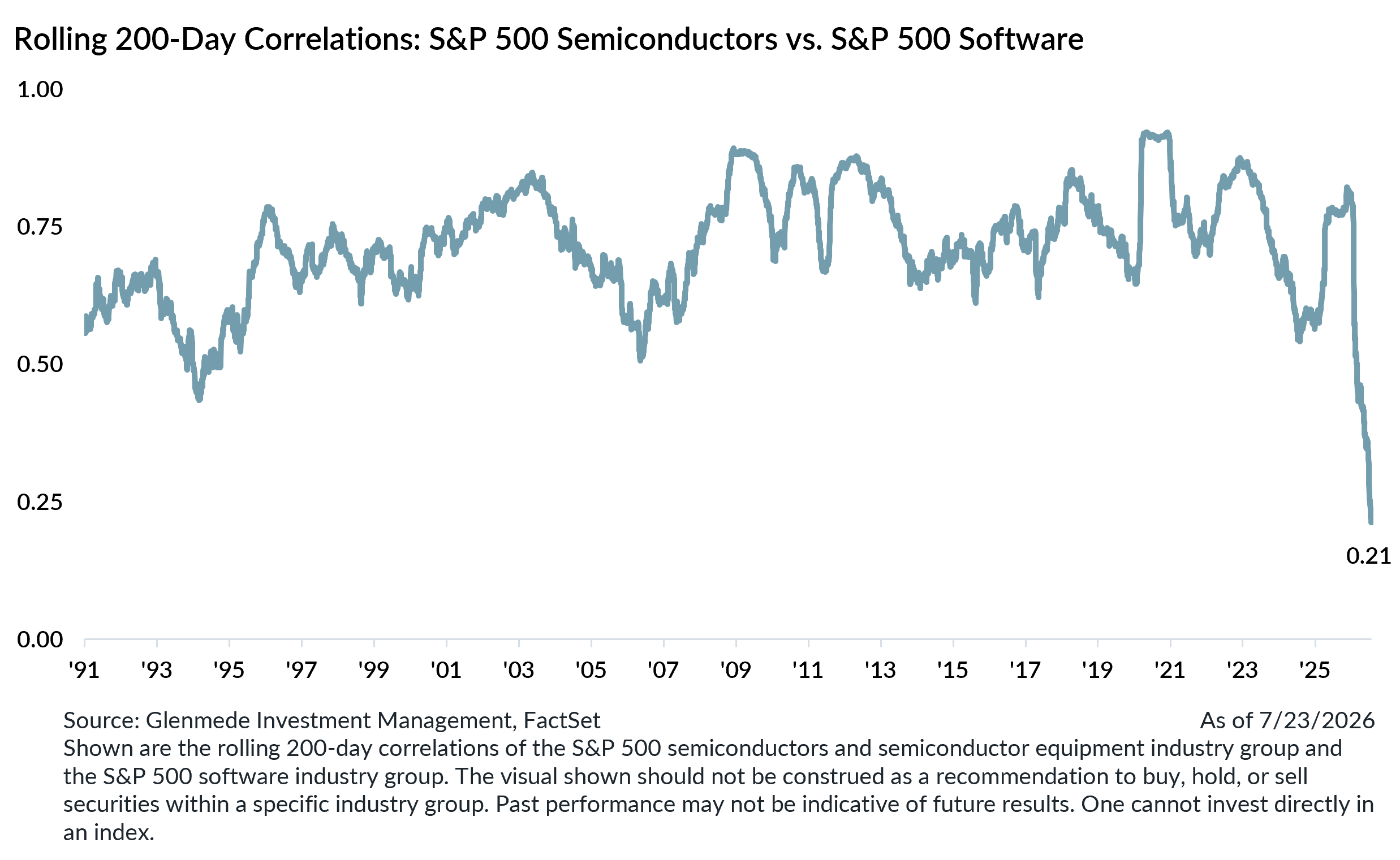
The split has not been confined to the market leaders, as the technology sector itself has divided. Semiconductors, the clearest AI beneficiaries, have separated from software, the apparent laggards, to a degree not seen in recent memory. These two industry groups have moved together with an average correlation of 0.73 over the past 30 years, a figure that never fell below 0.51 during that span. This year it dropped to 0.21.
The degree to which AI has genuinely reshaped the innovation story in the technology sector may offer an explanation for this break. These companies, once built on distinct and complementary business models, may have grown so large in aggregate that further gains increasingly come at one another’s expense, turning former collaborators into competitors for the same dollars.
The economic cause matters less than what the breakdown reveals. Market participants appear to be weighing individual companies on their own merits again rather than buying technology as a single thematic trade. For most of the past decade, owning the theme was enough. That no longer appears to be true.
For investors, this shift carries a constructive implication. When correlations compress and stocks move as a bloc, company-specific analysis adds little. When they separate, fundamentals reassert themselves and price discovery improves across the market. A backdrop in which semiconductors and software are judged on their own cash flows, rather than a shared AI narrative, is one where dispersion widens and individual security selection carries more weight than it has in years.
No single data point marks a turning point. But a 30-year correlation falling to a record low is worth attention.
Val deVassal, CFA
Portfolio Manager, Disciplined Equity
Glenmede Investment Management
Alex Atanasiu, CFA
Portfolio Manager, Disciplined Equity
Glenmede Investment Management
1 Sources for all data and statistics herein include Glenmede, FactSet, and the Fama-French Data Library as of 7/23/2026
2 The Magnificent 7 includes Amazon, Meta, Alphabet, Nvidia, Apple, Microsoft, and Tesla