
The Quarterly Recap Q3 2026: Economic & Market Recap
Executive Summary
- The Federal Reserve raised interest rates as inflation pressures persisted, while geopolitical tensions and shifting trade policy complicated an otherwise resilient economic backdrop.
- Long-term Treasury yields rose to multi-decade highs, reflecting an expanding term premium and competition for capital rather than inflation expectations or fiscal sustainability concerns.
- U.S. large cap stocks regained market leadership during the quarter, supported by exceptionally strong earnings growth, while several of the year’s earlier leaders gave back a portion of their gains.
- The outlook for economic growth remains constructive. Fed policy, the AI investment cycle, and midterm elections may be key market drivers in the months ahead.
Inflation Forces the Fed’s Hand
The Federal Reserve began its first tightening cycle since 2023, raising rates by a quarter point in September after concluding inflation was not making sufficient progress toward its 2% target. While early-summer data suggested price pressures were easing, August’s Consumer Price Index report came in firmer than expected, with headline prices rising 3.4% year over year and core inflation increasing 0.3% on the month. Services inflation remained stubbornly elevated, while higher oil prices tied to conflict in the Middle East reversed some earlier progress in food and energy inflation. At the same time, a resilient labor market, characterized by stronger payroll growth and a steady unemployment rate, left officials viewing employment risks as broadly balanced.
The U.S.-Iran conflict intensified during the quarter as the memorandum of understanding that had helped calm markets in June broke down and hostilities resumed. Shipping through the Strait of Hormuz became increasingly constrained, while disruptions around the Bab el-Mandeb and an attack on Saudi Arabia’s East-West Pipeline, a key alternative route for Gulf crude exports, raised concerns about the flow of energy and goods through some of the world’s most important trade corridors. Brent crude oil prices were exceptionally volatile, rising above $100 per barrel before ending the quarter at $98.
Trade policy continued to evolve during the quarter. Businesses received an additional $65 billion in tariff refunds tied to the Supreme Court’s February ruling against the use of the International Emergency Economic Powers Act to impose tariffs, bringing total refund disbursements to roughly $140 billion. The administration subsequently reimposed tariffs under Section 301 authorities in July, largely restoring the pre-ruling framework. While these changes created volatility in trade flows and muddied headline economic growth figures, underlying economic fundamentals remained solid. Healthy consumer spending and strong corporate profitability helped sustain growth, pointing to an economy that retained considerable momentum and strength.
The Rising Cost of Capital
While the Fed raised interest rates during the quarter, long-term Treasury yields had already been moving higher, with the 10-year Treasury yield exceeding 5.25% in September, its highest level since 2007, and the 30-year Treasury reaching a multi-decade high. Notably, the rise did not appear to reflect growing inflation expectations or mounting concerns about fiscal sustainability. Instead, yields moved higher as investors priced in a higher path for policy rates and demanded greater compensation to hold longer-dated bonds, (i.e., the term premium). Several factors likely contributed to that shift. The Fed’s balance sheet runoff left private investors absorbing a greater share of Treasury issuance, while the central bank’s retreat from the forward guidance framework reduced visibility into the future path of policy. Stronger economic growth contributed as well, as higher term premiums have historically accompanied strong economic conditions.
Demand for capital added further upward pressure on yields as AI hyperscalers continued to expand spending plans amid the accelerating infrastructure buildout. With capital expenditures rising and free cash flow under pressure, companies increasingly turned to debt markets to fund investment. Major hyperscalers have already issued $241 billion of debt this year, roughly double the prior year’s total. Taken together, the rise in long-term yields pointed less to inflation fears or fiscal concerns than to a central bank stepping back from bond markets just as an investment cycle of unusual scale increased comepetition for capital.
Markets Remain Resilient
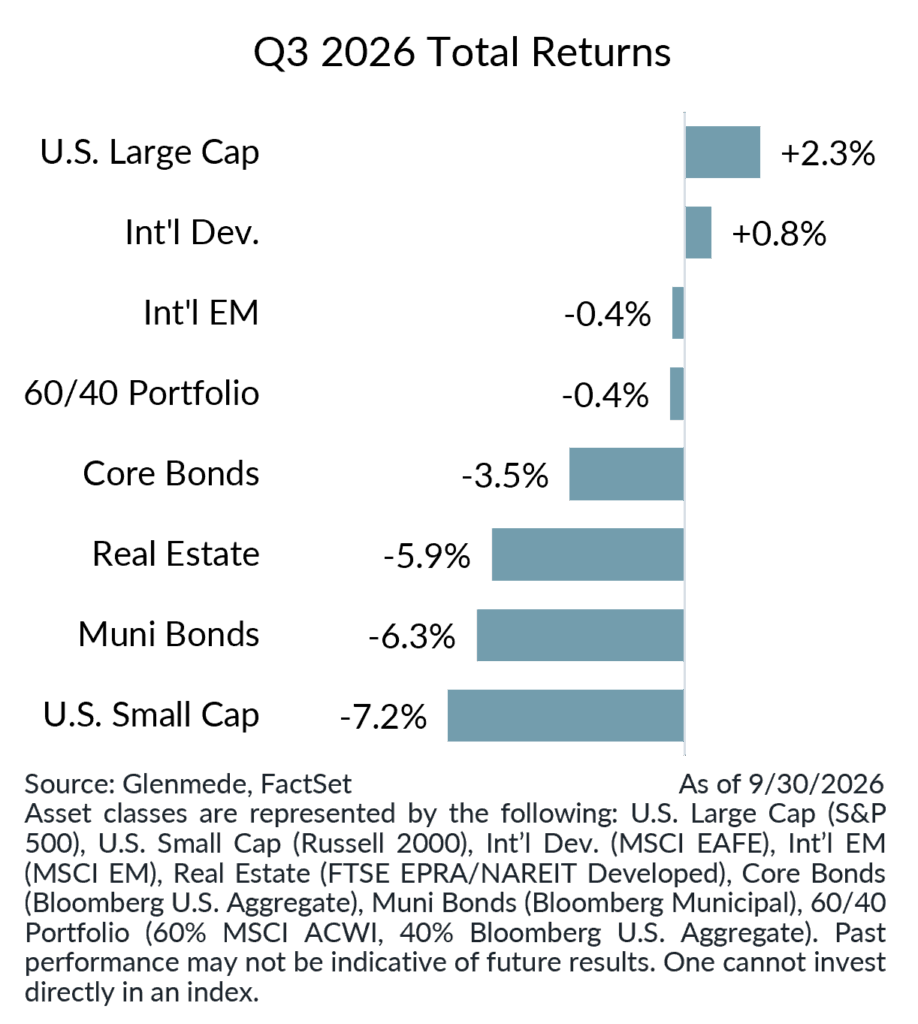
Equity markets were largely rangebound during the quarter, though pockets of strength emerged across asset classes. U.S. large cap stocks gained 2.3%, though breadth was weak with the average stock falling 1.9%. International developed and emerging market equities returned 0.8% and -0.4%, respectively. A diversified 60/40 portfolio fell 0.4% during the period. After leading markets earlier in the year, small cap stocks and real estate pulled back during the quarter, falling 7.2% and 5.9%, respectively. The quarter followed a very strong first half for equities, with corporate fundamentals remaining supportive.
Second quarter S&P 500 earnings grew 52% year over year, the fastest pace since 2021 and a seventh consecutive quarter of double-digit growth. Investment gains related to Alphabet’s stake in SpaceX and Amazon’s investment in Anthropic accounted for roughly 20 percentage points of that growth, though earnings still increased 32% excluding those items, underscoring the strength of corporate profit growth.
Fixed income underperformed as yields moved higher, with core bonds declining 3.5% and municipal bonds falling 6.3%. Gold gained 3.7%, while bitcoin surged 42.7% due to heightened demand for alternative stores of value.
Economic & Market Outlook: Currents Beneath a Rising Tide
Economic growth is expected to remain solid through the balance of the year, supported by resilient consumers and businesses. A healthy labor market underpins consumer spending, while corporate profits remain near record highs for businesses of all sizes. Although tariff-related developments may contribute to noise in the economic data, the underlying growth picture remains constructive.
The Federal Reserve’s path forward remains the central question for markets. Glenmede expects one additional quarter-point rate increase this year to move monetary policy into modestly restrictive territory, followed by a pause as policymakers assess the inflation outlook. The path beyond that will largely be dependent on progress toward 2% inflation. Stocks and bonds have historically delivered positive returns following the first rate hike of a tightening cycle, a pattern worth monitoring.
Artificial intelligence remains another important theme. Infrastructure spending shows little sign of slowing despite questions about the eventual return on investment, while AI’s impact on the labor market and economic growth may prove just as significant as the buildout itself. The upcoming midterm elections should also help bring the policy outlook for the next two years into focus. Markets currently favor Democrats gaining at least one chamber of Congress, creating the prospect of divided government that could constrain major legislation while leaving the administration substantial leeway over trade, immigration, and foreign policy.
Elevated valuations temper an otherwise constructive growth backdrop, though dispersion across regions and styles continues to create pockets of relative value, Fixed income yields remain compelling relative to recent history and should provide a more competitive source of income than they have for much of the past decade.
1 Asset classes are represented by the following: Large Cap (S&P 500), Small Cap (Russell 2000), Int’l Dev. (MSCI EAFE), Int’l EM (MSCI EM), Real Estate (FTSE EPRA/NAREIT Developed), Core Bonds (Bloomberg U.S. Aggregate), Muni Bonds (Bloomberg Municipal), 60/40 Portfolio (60% MSCI ACWI, 40% Bloomberg U.S. Aggregate). Past performance may not be indicative of future results. One cannot invest directly in an index.
This material was produced by Glenmede Investment Management, LP or its affiliate The Glenmede Trust Company, N.A. (collectively, “Glenmede”) for informational purposes and is not intended as personalized investment advice to purchase, sell or hold any investment or pursue any particular strategy. Opinions and analysis expressed in this material are those of the author or investment team as of the date of preparation and may change without this document being updated. Views expressed do not necessarily reflect the opinions of all investment personnel at Glenmede and may not be reflected in all the strategies and products offered. Forecasts or estimates provided herein, including those related to market outlook are based on research including publicly available information, internally developed data and third-party sources believed to be reliable, but accuracy cannot be guaranteed. Future results may differ significantly depending on market, security specific, economic or political conditions. Charts and graphs provided herein are for illustrative purposes only. Past performance is no guarantee of future results. Indexes mentioned are unmanaged and do not include any expenses, fees or sales charges. It is not possible to invest directly in an index. Any index referred to herein is the intellectual property (including registered trademarks) of the applicable licensor. Any product based on an index is in no way sponsored, endorsed, sold or promoted by the applicable licensor and it shall not have any liability with respect thereto. Financial intermediaries are only permitted to distribute this material in accordance with applicable law and regulation. Such financial intermediaries are required to satisfy themselves that the information in this material is appropriate for any person to whom they provide it. Glenmede shall not be liable for the use or misuse of this material by any such financial intermediary.