
Market Snapshot: Clearing the Midterm Overhang
The 2026 midterm elections are now in the rearview mirror, and the balance of power in Washington has shifted. Democrats appear to have secured majorities in both the House of Representatives and Senate, placing Congress in opposition to the White House and setting up a period of divided government for the final two years of the president’s term.
A congressional majority in opposition to the White House may move the center of gravity in Washington toward oversight and investigative efforts rather than sweeping and substantive legislation. Even so, selective cooperation with the White House remains possible where interests overlap: healthcare, measures aimed at the cost of living, and marginal adjustments to tax policy could all find a path forward.
Perhaps more importantly, the next two years may be headlined by a more energetic executive branch. Several of the administration’s biggest priorities, including trade, immigration, foreign policy, and deregulation, can be pursued or influenced largely through unilateral executive authority. The final stretch of the presidential term has also tended to become a period when administrations look to cement a legacy, and this one appears positioned to press those priorities with some vigor.
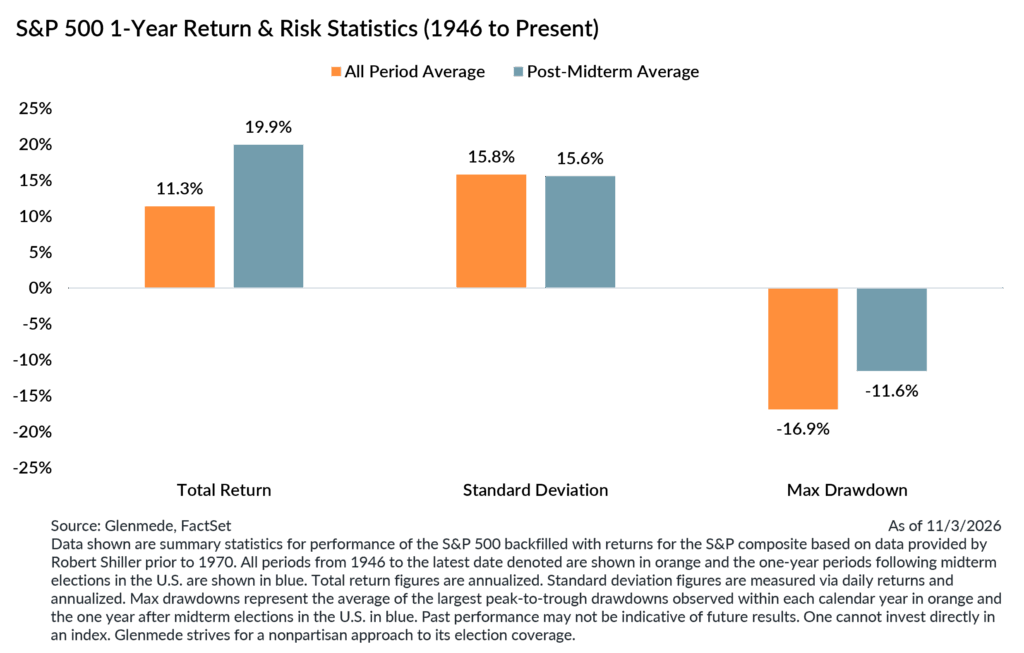
Beyond the specifics of the policy outlook, history offers a reasonably consistent pattern for how equities behave once midterm uncertainty clears, and there appears to be good reason for optimism. From 1946 to present, total returns for the S&P 500 in the 12 months following midterm elections have been 19.9% on average, which is well above the 11.3% average across the entire period. In fact, of the 20 midterm elections over this period, the S&P 500 has posted positive returns in every one-year period following.
Volatility has essentially been indistinguishable between post-midterm environments and all others, with the standard deviation of returns at 15.6% post-midterm versus 15.8% over the full history. The difference has shown up in the downside, as the average maximum drawdown in the year after midterms was 11.6%, compared with 16.9% across all periods. The most plausible read is that as the policy uncertainty that often accompanies an election year fades, markets have tended to find firmer footing.
Additionally, split control of the levers of power in Washington has historically been a boon for equity markets. Markets have historically performed poorly when one party can single-handedly push through legislation along party-line votes. The exercise of bipartisan compromise often provides checks and balances that limit sweeping changes to the rules of the road by which businesses and investors must abide. All else equal, this should be supportive for equities going forward.
Investors should be cautious not to interpret past results as a guarantee of future outcomes, particularly given the small sample size of 20 midterm elections over this period. Directionally, the record suggests equities have historically held up well in the year after midterms. For investors, the more durable lesson may be less about which party prevailed than about the resolution itself: markets tend to prefer a more predictable policy landscape, and the clearing of uncertainty has often mattered more than the specific result.
Jason Pride, CFA
Chief of Investment Strategy & Research,
Glenmede
Michael Reynolds, CFA
Vice President, Investment Strategy,
Glenmede