Market Snapshot: Four-Casting the Future of Work
Last week’s strong nonfarm payrolls print for August, rebounding from its negative print in July, is best interpreted as a confirmation that the labor market is experiencing volatility around its lower gear rather than as evidence it is shifting to a higher one. Yet employment has been holding up relatively well in this lower gear, given the continued “low hire, low fire” equilibrium that has prevailed for much of the last year.
Over the coming years, that equilibrium may come under strain, as two forces appear poised to reshape the labor market. On the demand side sits artificial intelligence. On the supply side sit demographics via an aging population and slower immigration.
The gut instinct for many is to picture an AI-driven wave of automation that hollows out employment within the next decade. The reality is likely to be much more layered and nuanced, running along four distinct paths:
This first is the simplest. AI resistant work represents the reality that many jobs are unlikely to see much effect at all from AI. Work that resists automation, from skilled trades to hands-on services, should continue to grow roughly in line with the broader economy.
The second path is AI automatable work, where large language models perform tasks on their own and fewer workers are needed. Rote data entry and some customer service roles may fit in this category.
The third, and less intuitive, is augmentation, where AI raises workers’ productivity rather than replacing them. Here a familiar dynamic can take hold, an echo of the Jevons paradox. As a task becomes cheaper and more capable, demand for it can expand, in turn lifting demand for the workers who help deliver it. Health care is a natural example, where tools that absorb routine work may free clinicians to see more patients, which may lead to higher demand for support staff.
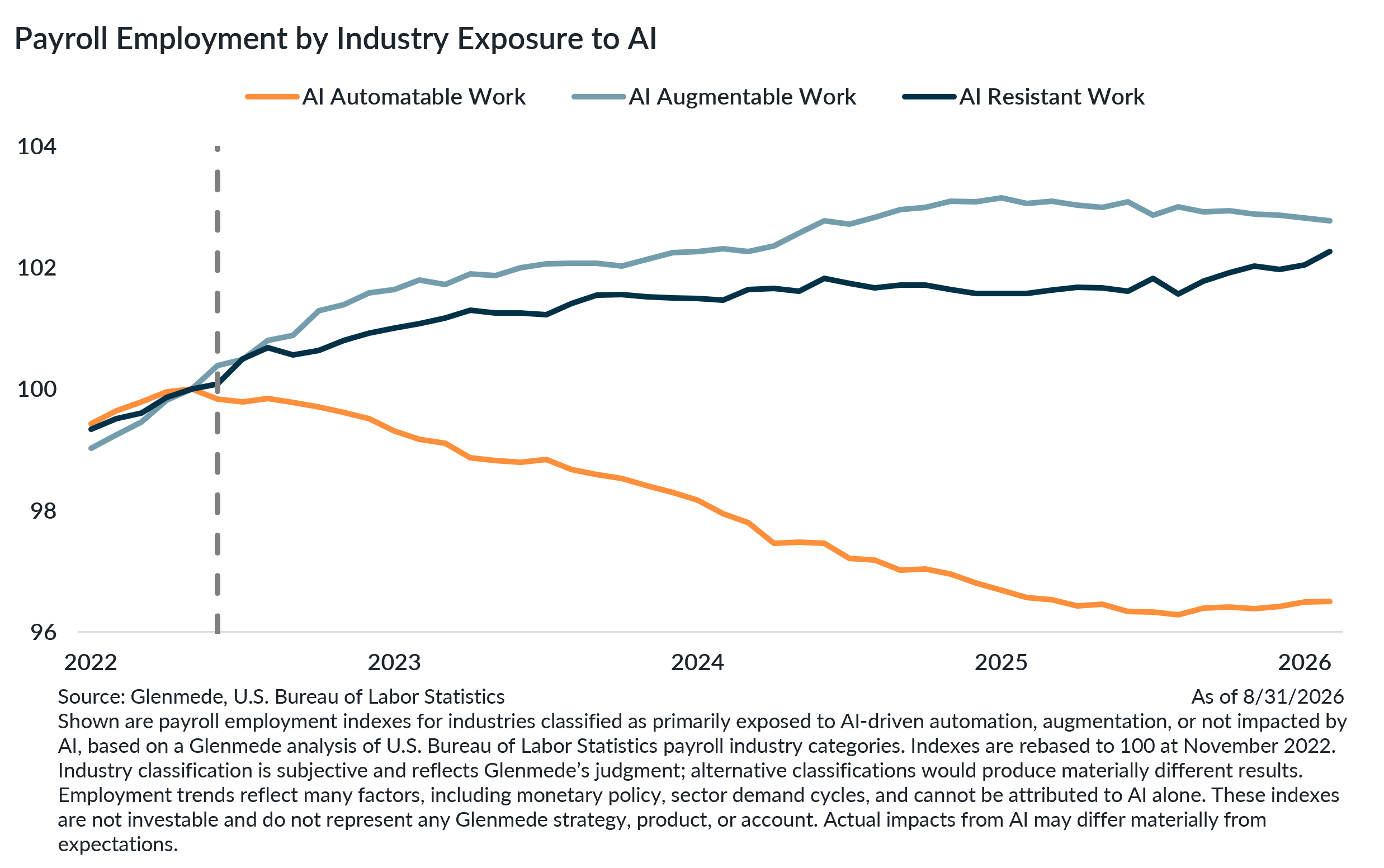
Since ChatGPT’s launch, payrolls have diverged across these categories. Employment in automation-exposed industries has fallen 3.5% below its late-2022 level. In contrast, employment in augmentation-exposed industries has risen 2.8% above it. Employment in AI-resistant industries has risen by a similar margin, which suggest factors beyond AI may be contributing to the divergence. Nevertheless, the gap between the two has slowly but steadily widened over this period.
The fourth path is the one current data cannot capture: entirely new and emergent jobs, occupations, and industries that AI is likely to create but that are difficult to imagine today. A parent raising children in the mid-1990s would have been hard pressed to tell their children they could one day become a social media influencer or professional gamer. Yet the steady flow of innovation unlocked by the internet has opened doors many did not even know were there. AI may lead to similar innovations in the menu of job opportunities in the years ahead.
The pace of AI-driven displacement remains impossible to forecast with confidence. Yet those preoccupied with how fast AI destroys jobs may be missing the bigger picture: in an economy potentially facing a shortage of workers rather than a shortage of work, the question may be less whether the jobs endure than who may be left to fill them.
Jason Pride, CFA
Chief of Investment Strategy & Research, Glenmed
Michael Reynolds, CFA
Vice President, Investment Strategy, Glenmede
1 Shown are payroll employment indexes for industries classified as primarily exposed to AI-driven automation, augmentation, or not impacted by AI, based on a Glenmede analysis of U.S. Bureau of Labor Statistics payroll industry categories. Indexes are rebased to 100 at November 2022. Industry classification is subjective and reflects Glenmede’s judgment; alternative classifications would produce materially different results. Employment trends reflect many factors, including monetary policy, sector demand cycles, and cannot be attributed to AI alone. These indexes are not investable and do not represent any Glenmede strategy, product, or account. Actual impacts from AI may differ materially from expectations.
This material was produced by Glenmede Investment Management, LP or its affiliate The Glenmede Trust Company, N.A. (collectively, “Glenmede”) for informational purposes and is not intended as personalized investment advice to purchase, sell or hold any investment or pursue any particular strategy. Opinions and analysis expressed in this material are those of the author or investment team as of the date of preparation and may change without this document being updated. Views expressed do not necessarily reflect the opinions of all investment personnel at Glenmede and may not be reflected in all the strategies and products offered. Forecasts or estimates provided herein, including those related to market outlook are based on research including publicly available information, internally developed data and third-party sources believed to be reliable, but accuracy cannot be guaranteed. Future results may differ significantly depending on market, security specific, economic or political conditions. Charts and graphs provided herein are for illustrative purposes only. Past performance is no guarantee of future results. Indexes mentioned are unmanaged and do not include any expenses, fees or sales charges. It is not possible to invest directly in an index. Any index referred to herein is the intellectual property (including registered trademarks) of the applicable licensor. Any product based on an index is in no way sponsored, endorsed, sold or promoted by the applicable licensor and it shall not have any liability with respect thereto. Financial intermediaries are only permitted to distribute this material in accordance with applicable law and regulation. Such financial intermediaries are required to satisfy themselves that the information in this material is appropriate for any person to whom they provide it. Glenmede shall not be liable for the use or misuse of this material by any such financial intermediary.