
Market Snapshot: The Post-Midterm Policy Roadmap
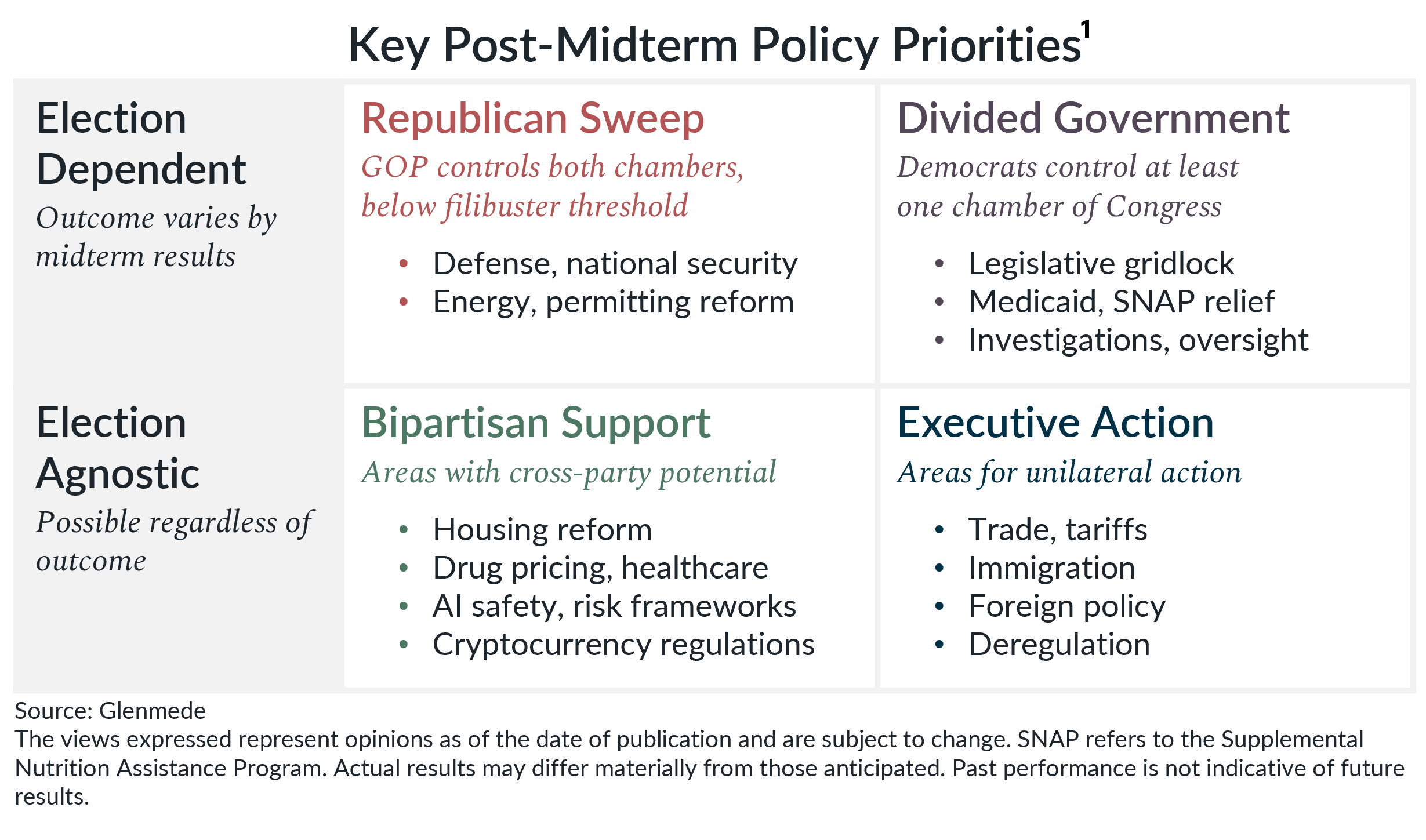
The 2026 midterm elections are beginning to attract investor attention, and for good reason. Control of Congress will influence the legislative agenda during the final two years of President Trump’s term. While prediction markets currently suggest divided government is the most likely outcome, election forecasts remain highly uncertain and several months remain before voters head to the polls.
Forecasting election outcomes is not the objective. Instead, understanding how different electoral outcomes could shape the policy environment may prove more valuable for investors.
Conceptually, the post-midterm landscape can be divided into three broad outcomes: a strong sweep, a weak sweep, and divided government. A strong sweep occurs when one party controls the White House, House of Representatives, and Senate while also holding a filibuster-proof majority in the Senate. A weak sweep occurs when one party controls all three but lacks 60 Senate votes, limiting the scope of legislative change. Divided government occurs when control of Washington is, in any combination, split between the parties.
Of these possibilities, a strong sweep appears effectively off the table. Even under an optimistic scenario for Republicans, a filibuster-proof Senate majority remains highly unlikely. The more realistic outcomes are either a weak Republican sweep or some form of divided government. The House remains the key swing factor. Redistricting efforts appear to provide Republicans with a potential 5–7 seat net tailwind. History cuts in the other direction: since 1942, the party controlling the White House has lost House seats in 19 of 21 midterm elections.
Historically, markets have exhibited a preference for those outcomes. Since 1872, U.S. large cap equities have generated annualized inflation-adjusted returns of roughly 9.3% under weak sweep environments and 7.7% under divided government, compared with just 1.5% during strong sweep periods.² While many factors influence market returns, investors have often embraced the policy certainty and moderation that accompany legislative constraints.
What might the policy priorities be for the incoming 120th Congress? Under a Republican sweep, areas such as defense spending, national security initiatives, energy policy, and permitting reform may be priorities. Divided government would likely reduce the pace of major legislative initiatives while increasing the focus on oversight and potential revisions to portions of recent legislation. However, some issues may find support regardless of election outcomes. Housing reform, healthcare and drug pricing measures, AI safety frameworks, cryptocurrency regulation, and certain export control policies all retain some elements of bipartisan appeal.
The second half of a final presidential term also introduces a dynamic that has not previously existed during the Trump presidency. Following the midterms, neither President Trump nor his party will face another national election with him atop the ticket. Whether that results in a more aggressive use of executive authority remains uncertain, but it could be the impetus for a more energetic pursuit of policy priorities in areas such as trade, immigration, foreign policy, and deregulation, regardless of the balance of power in Congress.
While the economic and market implications of the midterms remain uncertain, the range of plausible outcomes appears skewed toward either divided government or a weak governing majority. Historically, such environments have favored policy stability and incremental change rather than sweeping legislative shifts. While executive action will remain an important force shaping trade, immigration, foreign policy, and regulation, the most likely election outcomes appear more supportive of the status quo than transformative change, a backdrop that has generally been constructive for economic expansions and bull markets.
Jason Pride, CFA
Chief of Investment Strategy & Research
Glenmede
Michael Reynolds, CFA
Vice President, Investment Strategy
Glenmede
1 The views expressed represent opinions as of the date of publication and are subject to change. SNAP refers to the Supplemental Nutrition Assistance Program. Actual results may differ materially from those anticipated. Past performance is not indicative of future results.
2 U.S. large cap equities are represented by the S&P 500, backfilled with returns for the S&P composite based on data provided by Robert Shiller prior to 1970 and Ibbotson prior to 1926. Long-run regime averages may mask volatility associated with, but not limited to, drawdowns, recessions, and bear markets.
This material was produced by Glenmede Investment Management, LP or its affiliate The Glenmede Trust Company, N.A. (collectively, “Glenmede”) for informational purposes and is not intended as personalized investment advice to purchase, sell or hold any investment or pursue any particular strategy. Opinions and analysis expressed in this material are those of the author or investment team as of the date of preparation and may change without this document being updated. Views expressed do not necessarily reflect the opinions of all investment personnel at Glenmede and may not be reflected in all the strategies and products offered. Forecasts or estimates provided herein, including those related to market outlook are based on research including publicly available information, internally developed data and third-party sources believed to be reliable, but accuracy cannot be guaranteed. Future results may differ significantly depending on market, security specific, economic or political conditions. Charts and graphs provided herein are for illustrative purposes only. Past performance is no guarantee of future results. Indexes mentioned are unmanaged and do not include any expenses, fees or sales charges. It is not possible to invest directly in an index. Any index referred to herein is the intellectual property (including registered trademarks) of the applicable licensor. Any product based on an index is in no way sponsored, endorsed, sold or promoted by the applicable licensor and it shall not have any liability with respect thereto. Financial intermediaries are only permitted to distribute this material in accordance with applicable law and regulation. Such financial intermediaries are required to satisfy themselves that the information in this material is appropriate for any person to whom they provide it. Glenmede shall not be liable for the use or misuse of this material by any such financial intermediary.