
Market Snapshot: Writing the Odds of a Longer Retirement
Goals-based investing is a simple idea: a portfolio succeeds not when it beats a benchmark in a given year, but when it delivers the highest likelihood that it meets the investor’s goals. For many individual investors, the need that matters most is portfolio durability to fund a stream of withdrawals across a retirement that could last decades.
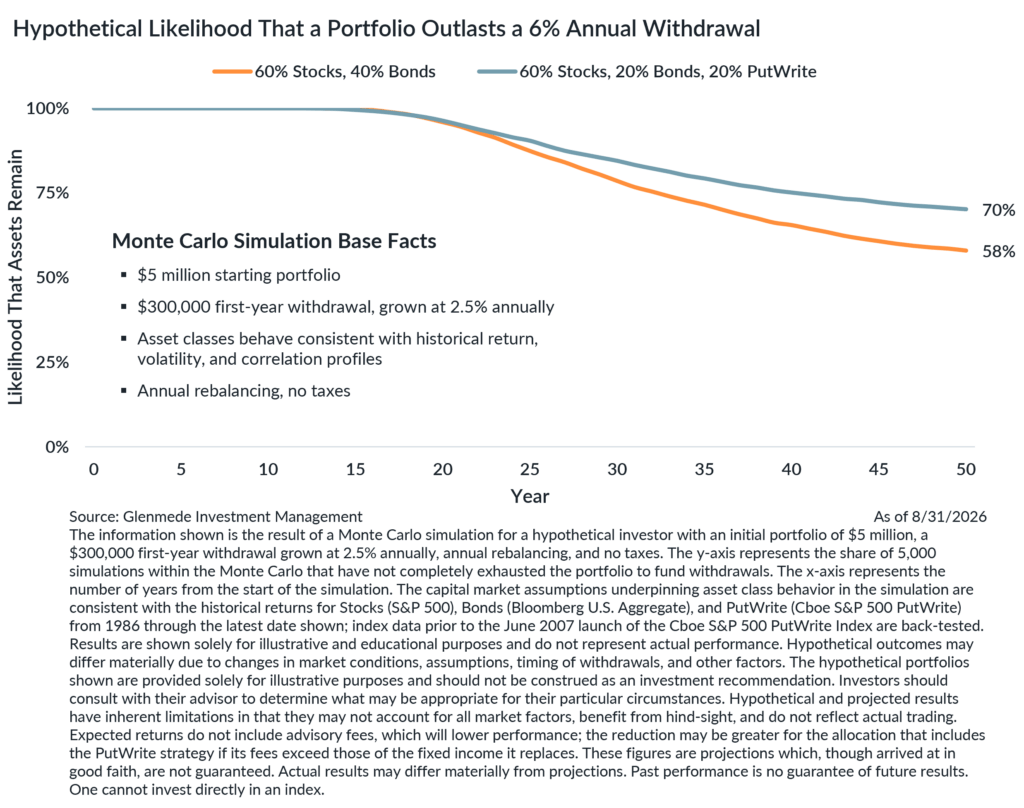
That reframing can change how risk is measured. Consider a hypothetical example of a $5 million portfolio funding a 6% first-year withdrawal ($300,000) growing at 2.5% annually to keep pace with inflation. Assuming the behavior of asset classes is roughly in line with their historical record, a Monte Carlo simulation finds that a traditional 60% stock, 40% bond portfolio has a reasonable likelihood of meeting this goal over the first two decades. However, as the horizon extends, the odds begin to erode. At 50 years, that portfolio is estimated to have a 58% chance, before advisory fees, of retaining the capacity to fund its withdrawals.
For an investor concerned with longevity risk, the prospect of outliving the portfolio is the central problem. While a low likelihood of success may be cause to reassess goals, the advisor’s role is to seek solutions that meet them as originally prescribed. One such solution may be replacing a portion of the bond allocation with a secured put writing strategy. More specifically, a 60% stocks, 20% bonds, 20% “PutWrite” portfolio may improve those odds, raising the 50-year success probability in the simulation from 58% to 70% before advisory fees.
Put writing carries risks that bonds do not: the strategy participates in index declines below the strike price, its gain is limited to the premium received, and losses may exceed that premium. It is not a substitute for the volatility dampening core fixed income provides. The improvement comes from the return profile of writing puts. The strategy collects option premium as income while retaining equity market exposure, producing a return stream that, over the 1986 to 2026 period studied, delivered a higher total return than the Bloomberg U.S. Aggregate, with materially higher volatility and deeper drawdowns.
In addition, one potential advantage of incorporating cash-secured put strategies is that they may reduce duration risk. For retirees, one of the greatest uncertainties is inflation’s impact on future purchasing power, while duration risk can significantly impair bond returns during periods of rising interest rates. The cash backing a cash-secured put position earns the short-term interest rate embedded in option pricing, substituting short-rate exposure for the term exposure of a traditional bond allocation. That reduces sensitivity to rising long-term rates, and it also forgoes the gains a longer-duration allocation can produce when rates fall. This can improve portfolio resilience by reducing reliance on duration-bearing fixed income while maintaining an income-generating component within the portfolio, particularly in a rising rate environment.
Reality can intrude in ways a Monte Carlo simulation set to zero taxes may not capture. With that said, a well-constructed put writing program may help at the margin rather than hurt. Writing puts generates cash proceeds that can be redeployed into whatever the portfolio is underweight, feeding the ongoing rebalancing process with new cash rather than forcing sales of appreciated holdings. That mechanism can defer the realization of embedded equity gains and, if the puts are written on broad-based indices, the premium itself may qualify for treatment under Section 1256 of the Internal Revenue Code, which is generally more favorable than ordinary income treatment. The case could be stronger for a more nuanced portfolio construction on an after-tax basis. The simulation does not model taxes, so no after-tax effect is reflected in the probabilities shown.
No single allocation can guarantee that a portfolio will outlast its owner’s spending habits, and the future may look materially different than the outcomes of a simulation. But the goals-based frame clarifies what investors are really solving for. When the objective is the probability of meeting a long-dated commitment rather than the return in any one year, the tools that improve those odds deserve a closer look, even when they sit outside the traditional stock-and-bond toolkit.
Sean Heron, CFA
Portfolio Manager, Derivatives,
Glenmede Investment Management