
Thought Leadership
 Insights
March 27, 2024
Insights
March 27, 2024
A Strong Track Record Glenmede Investment Management, LP is pleased to announce that the Glenmede Quantitative U.S. Large Cap Core Equity Portfolio (GTLOX), launched on February 27, …
Insights
March 27, 2024
A Strong Track Record Glenmede Investment Management, LP is pleased to announce that the Glenmede Quantitative U.S. Large Cap Growth Equity Portfolio (GTLLX), launched on February 27, …
 Insights
March 13, 2024
Insights
March 13, 2024
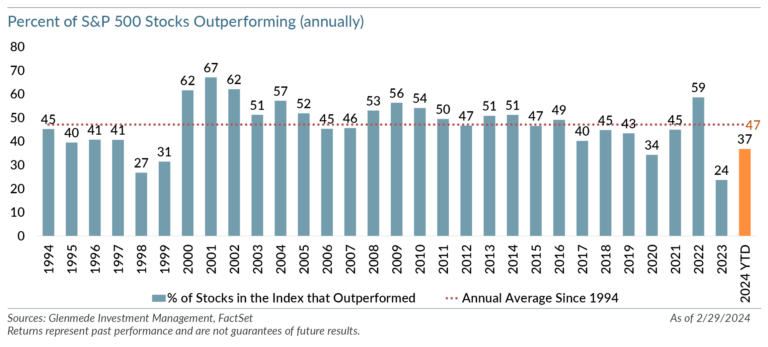
As of the first two months of 2024, market participation of the S&P 500 constituents has increased from last year’s 30-year lows. As shown in the chart, …
 Insights
March 05, 2024
Insights
March 05, 2024
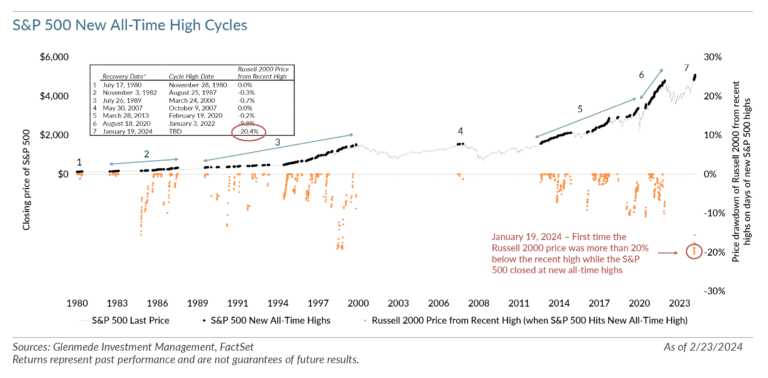
The S&P 500 began a new all-time high price cycle¹ on January 19, 2024, and as of February 23 had posted 13 new all-time highs during 25 …
 News
February 27, 2024
News
February 27, 2024
Glenmede Investment Management Appoints Scott J. Kearney as Director of Global Distribution Philadelphia, PA — February 27, 2024 — Glenmede Investment Management (GIM), an independently owned boutique …
 Insights
February 08, 2024
Insights
February 08, 2024
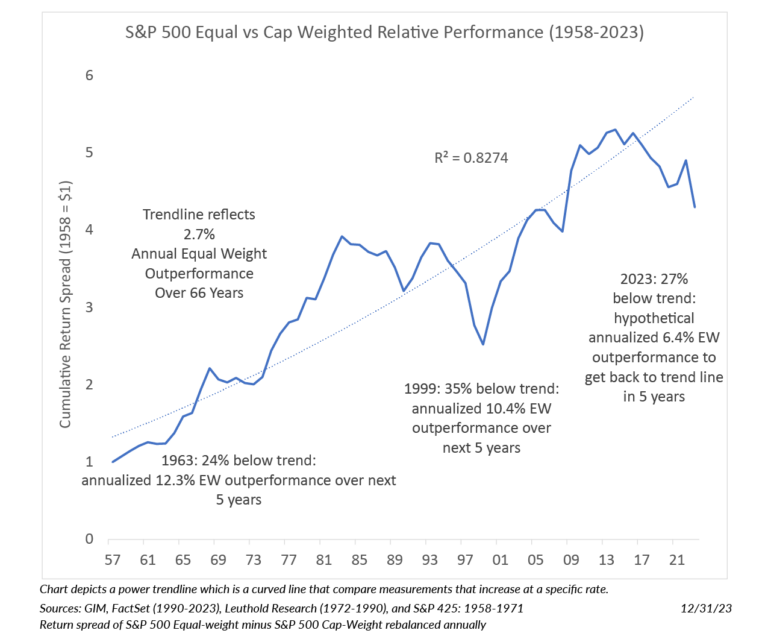
We have repeatedly discussed the increase in market concentration¹ for U.S. large cap stocks and the potential concentration risk for investors in large cap passive strategies. The …
 Insights
January 23, 2024
Insights
January 23, 2024
We are seeing unprecedented market concentration in broad-based indices.
 Insights
January 03, 2024
Insights
January 03, 2024
Beyond the Surface: Peripheral Impacts of a Higher Cost of Capital on Small Cap Markets In our October 2020 paper “Why Profitability Matters: Positive Versus Negative Earnings,” …
 Insights
November 07, 2023
Insights
November 07, 2023
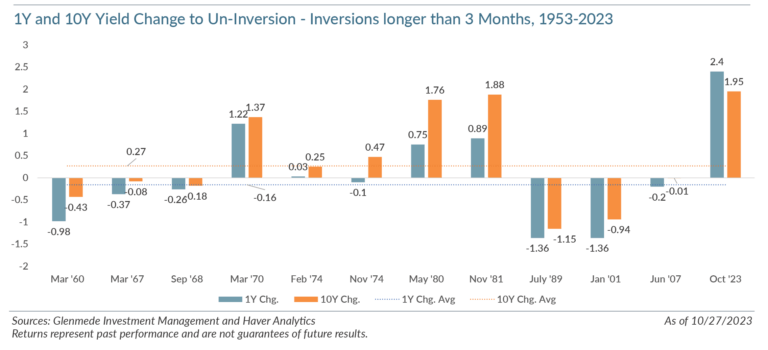
Instead of debating the likelihood of a recession, we compare the behavior of the yield curve during the “un-inversion.”
Insights
October 19, 2023
We are seeing unprecedented market concentration in broad-based indices.